How it plays
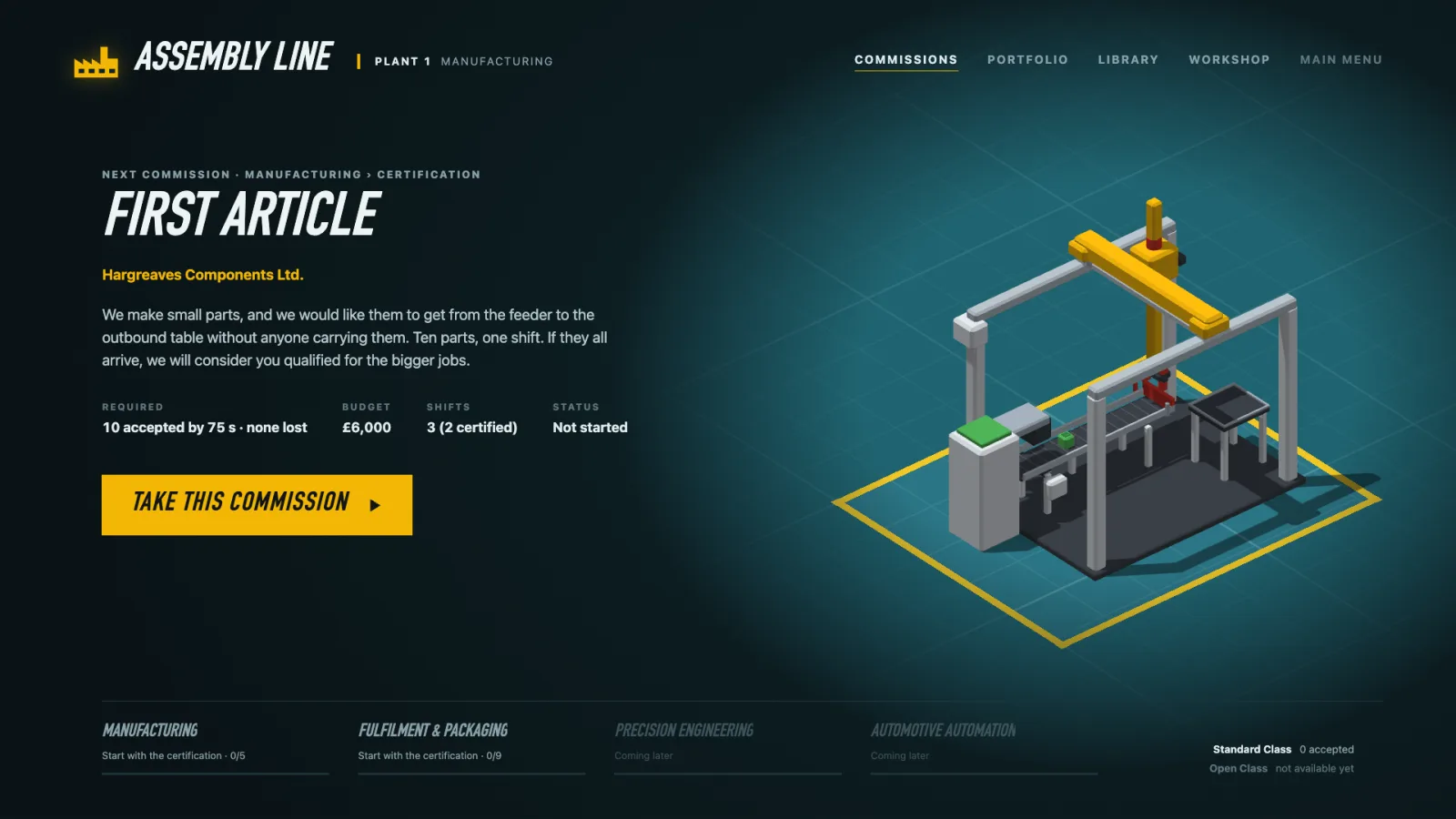
A client, a floor, and a budget
A client describes what they need moved, sorted, pressed, measured or assembled. You are given an empty floor and money for equipment. What you build, and what you write, has to do the job for real.
-
01
Build the cell
Place gantries, pickers, conveyors, pushers, gauges and beam sensors on an isometric floor, and wire each sensor and drive to the robot that will use it.
-
02
Program every robot
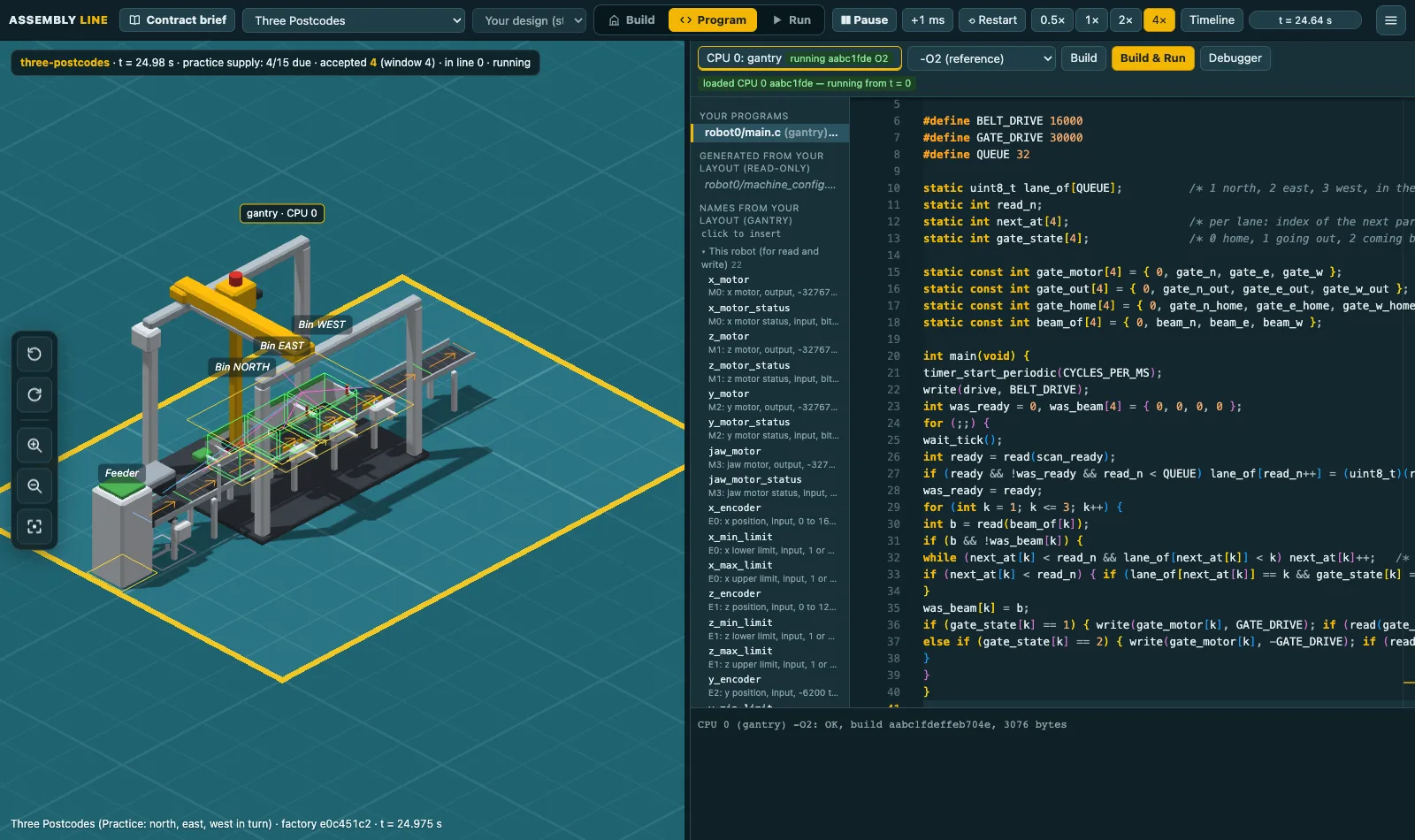
Each robot has its own controller. Nothing moves until you tell it to: when to pick, where to place, what to do when the beam is broken.
-
03
Run the shift
Parts arrive on their own schedule. A dropped part stays dropped and a jam stays jammed. You are scored on what physically reaches the client.
The machine
A real processor in every robot
Every robot on the floor has its own emulated Motorola 68000 running at 8 MHz. Your program is compiled to real machine code and runs on that processor. It reaches the motors and sensors the way real firmware does, through memory-mapped hardware.
So processor time is part of the puzzle. A controller that polls too slowly misses the part. Two robots that share a table have to agree who goes first.
Four ways to program
Start with arrows. End in assembly.
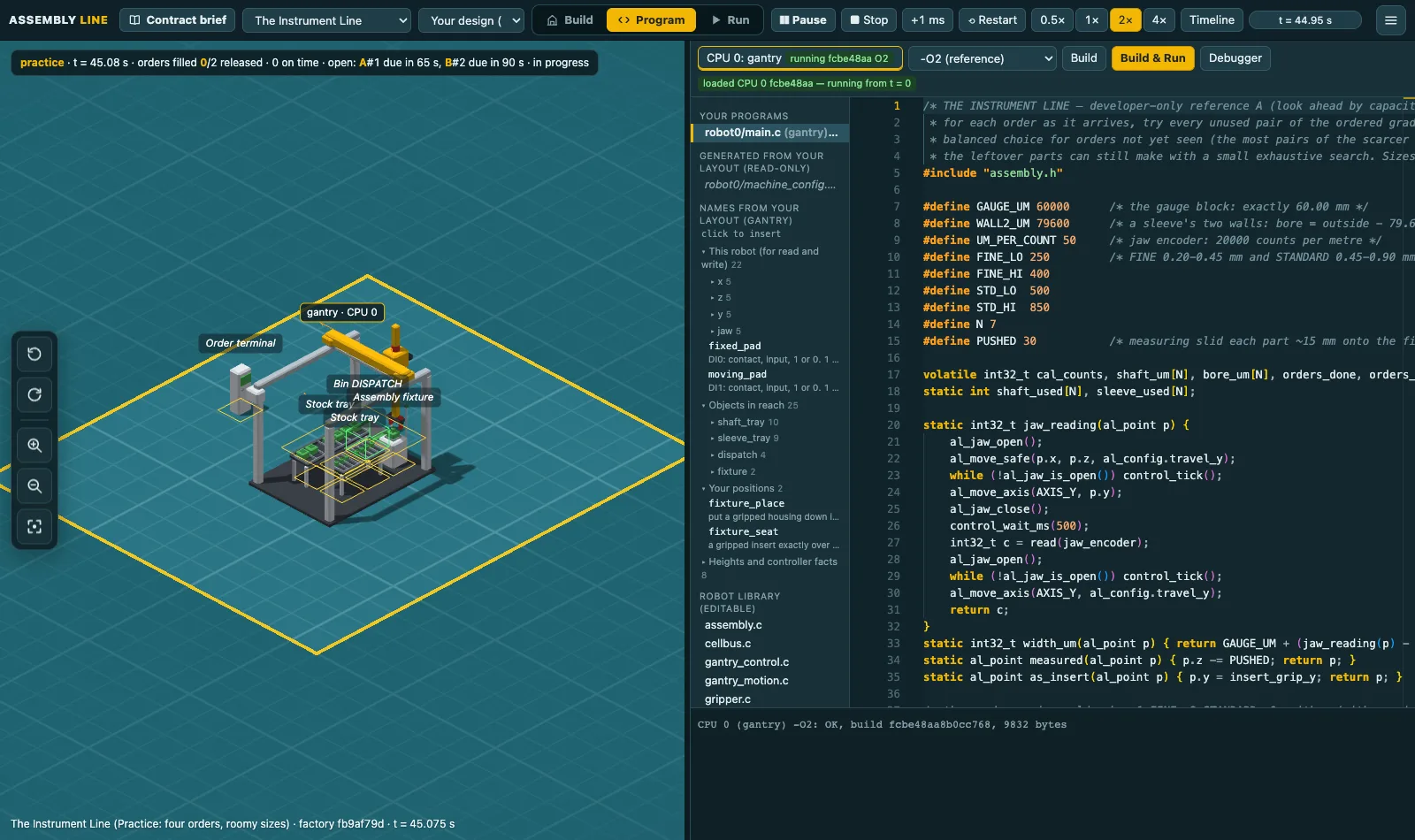
The same robots take four kinds of program, and all four run on the robot's own processor. The easier ones cost more processor time, which is the reason to learn the next.
-
Flow
Steps on a canvas, joined by arrows. The first lessons are flows, and any flow can be turned into text when you outgrow it.
-
Gaffer
A small language that reads like instructions to a foreman:
wait until,pick,place,if. It runs on a virtual machine inside the robot. -
C
Real C, built by the game's own compiler, with a library you can read and change. Fast, complete and unforgiving.
-
68000 assembly
For when every cycle counts.
The tools
Stop it mid-shift and look
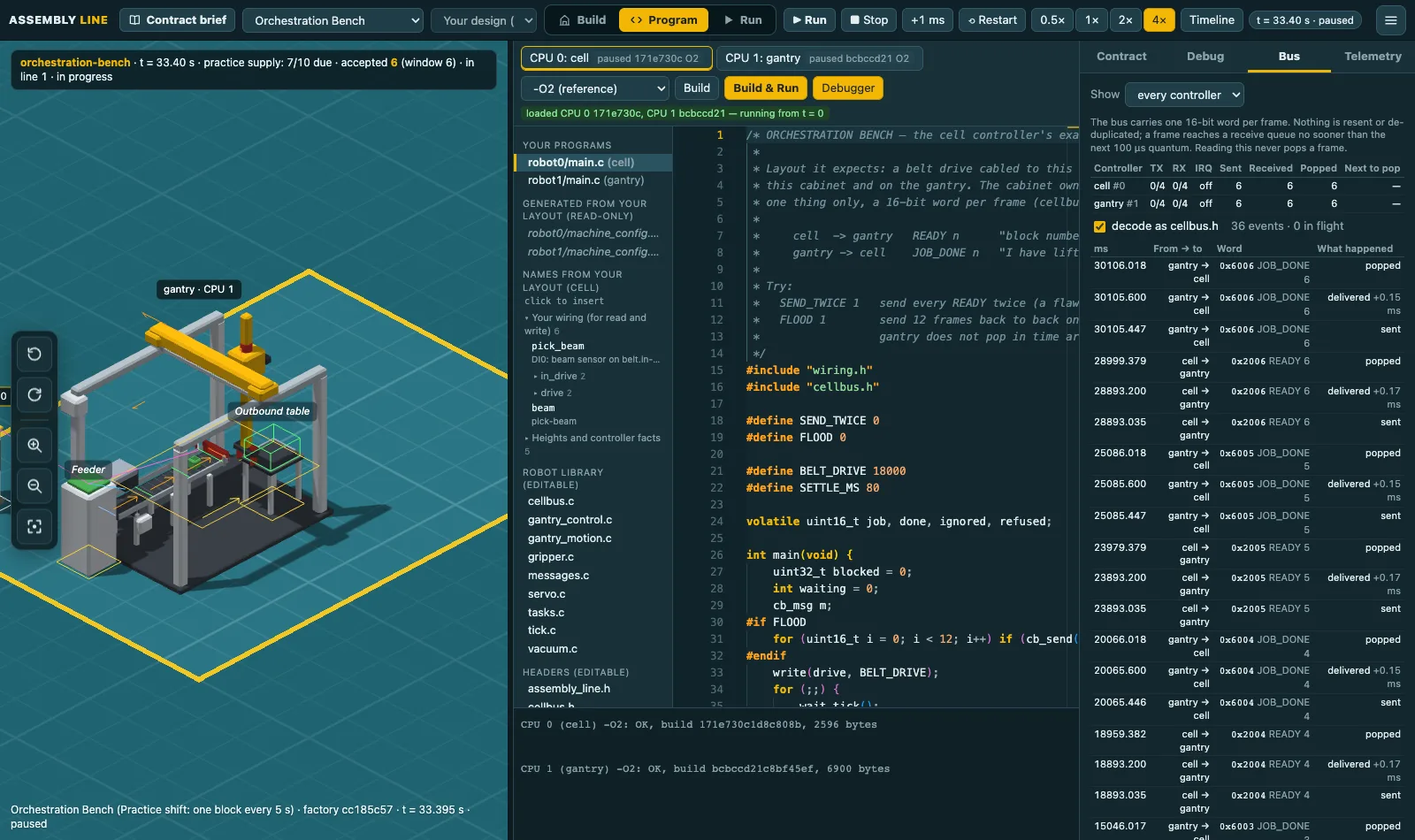
Set a breakpoint and the whole factory stops on it. Step through your code line by line, read the variables, and trace the messages robots send each other.
The simulation is deterministic: the same build and the same program give the same shift every time, so a failure can always be replayed.
The work
From ten parts on a belt to a full line
Commissions come from whole industries, each with its own equipment and its own problems: manufacturing, fulfilment and packaging, precision engineering. They start with one robot and one belt, and build to cells where several robots share the work.
Coming soon
Hear when you can play it
Assembly Line isn't out yet. Leave your email and you'll hear when there is something to play.
This signs you up to Playable Things, James Randall's newsletter: playtests, early builds of new games, and the occasional release. Nothing else.